
Published by Vince Baker Ministries ·
What did Caleb say before he asked for the mountain?
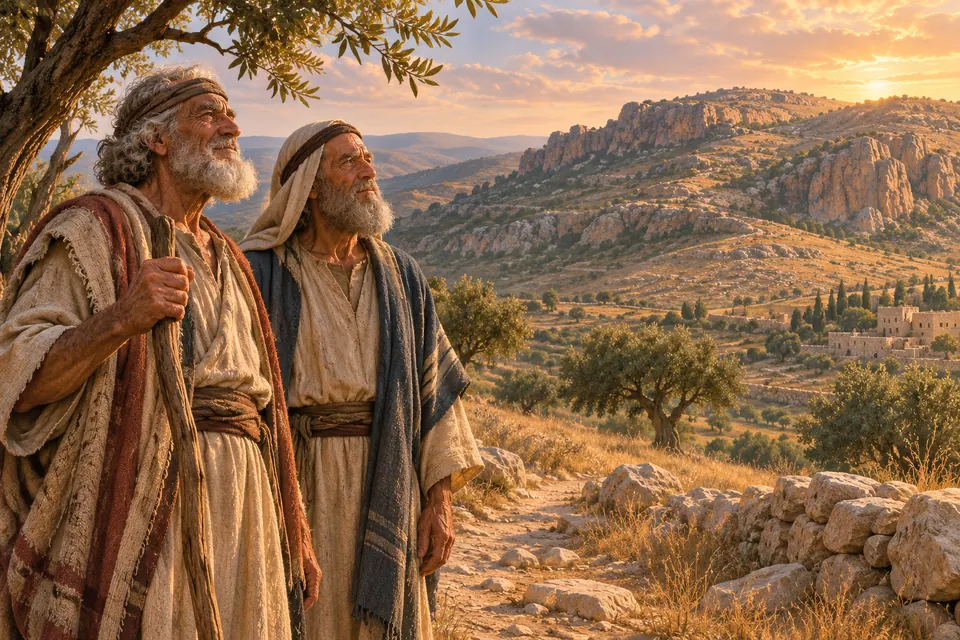
Caleb was eighty-five when he stood before Joshua to ask for the hill country. But the first thing he brought up was something Joshua had heard forty-five years earlier. Read Joshua 14:6–12 (KJV) and notice the order: Caleb recalls what God said, tells what God has done in the years since, and only then asks for the mountain. That order gives us a way to think about faith when a long wait has changed the circumstances.
Joshua 14:6 places the conversation at Gilgal, as Israel was receiving its tribal allotments. Caleb begins by taking Joshua back to Kadeshbarnea, where Moses had sent him to search out the land. Caleb says he was forty then. By verse 10 his testimony is as much about the intervening years as it is about the mountain: “the LORD hath kept me alive.” Caleb can name evidence of God’s care while the inheritance is still ahead of him.
What had God actually promised Caleb?
To see what Caleb was remembering, go back to Numbers 13:25–33 and 14:6–9 (KJV). The men who returned from scouting Canaan described good land, strong inhabitants, and fortified cities. Caleb urged Israel to go forward. Later, Caleb and Joshua spoke together, calling the people to trust the Lord’s presence rather than turn back in fear. They had seen the same land as the others. The difference was how they understood what they had seen in light of what the Lord had said.
In Numbers 14:24 (KJV), God says Caleb “hath followed me fully” and promises to bring him into the land he had visited and give it to his descendants. Deuteronomy 1:34–36 (KJV) repeats the promise, and Joshua 14:9 records Caleb recalling Moses’ oath. The promise concerns a particular inheritance in Israel’s story. Before drawing a lesson for today, it helps to say exactly what God promised, to whom He promised it, and what He asked of His people.
Why did Caleb still mention fortified cities?
Here is the tension in Caleb’s request. Forty-five years had passed, but he still described the very obstacles that had frightened Israel at Kadeshbarnea. Joshua 14:12 (KJV) names the Anakim and the great, fortified cities in the same breath as the request, “give me this mountain.” What kind of confidence can speak that honestly about what stands in the way?
Caleb’s next words point to the Lord’s presence. The KJV phrase “if so be the LORD will be with me” puts the success of the undertaking in God’s hands. Caleb is willing to do the work, and he knows whose help he needs. Verse 13 records Joshua blessing him and assigning Hebron to him. Joshua 15:13–14 (KJV) then tells what taking possession involved, reporting that Caleb drove out three descendants of Anak. Receiving the allotment and taking possession are two distinct moments in the account.
That distinction can help when you are facing an ordinary act of obedience. Being clear about what is right does not make a difficult conversation easy. You may still need wise counsel, time to prepare, or help from someone who knows the situation. Caleb’s example makes room for naming real difficulties and taking responsibility for the next action.
What does following the Lord fully look like while you wait?
Numbers 14 and Joshua 14 both describe Caleb as following the Lord fully. Scripture gives us key moments from those decades rather than a record of every day. In the first, Caleb stands with Joshua while much of Israel wants to turn back. In the second, he returns to what God said and acts when Israel is dividing the land. The same commitment is visible at both ends of the wait.
One way to practice this kind of faith is to keep your attention on what you can obey now. Perhaps you are praying about a decision whose outcome you cannot control. You can still keep your word to someone, tell the truth about a mistake, or offer help to a person in need. Over time, those decisions give shape to the faith you say you are holding on to. Hebrews 10:35–36 (KJV) likewise connects confidence, patience, and doing the will of God.
It also helps to keep a prayer request and a promise in separate columns. You may pray boldly for a job, an opportunity to serve, or reconciliation with someone you love. You can trust God with those requests while acknowledging that you do not know how or when they will be answered. The commands to tell the truth, love your neighbor, and pray for others still give you something definite to do. Caleb could name the particular word he had received. Reading that word in its own setting helps us put our confidence in what God actually says.
What is one faithful step you can take this week?
Read Numbers 14:6–9 and 24, then Joshua 14:6–14 (KJV). On a page, write three short lines. First, record what the passage actually says God promised Caleb. Second, name a clear responsibility Scripture gives you today, such as speaking truthfully or pursuing peace where possible. Third, choose one action you can take on that responsibility within the next seven days. Be specific enough to know when you have done it.
If you have been waiting on a conversation, that action might be to make a respectful request to talk and prepare to listen. If you have put off a promise you made to someone else, contact them and take the first step toward keeping it. Pray for wisdom and ask someone you trust to check in with you. You can honor God in a real action this week while the larger outcome is still uncertain.
Read the Scripture passages
- Joshua 14:6-15 · KJV
- Numbers 13:25-33 · KJV
- Numbers 14:6-9 · KJV
- Numbers 14:24 · KJV
- Deuteronomy 1:34-36 · KJV
- Joshua 15:13-14 · KJV
- Hebrews 10:35-36 · KJV