By Vince Baker · · Updated
What was The Apostolic Faith newspaper?
The Apostolic Faith was the newspaper of the Azusa Street Mission at 312 Azusa Street in Los Angeles. The Flower Pentecostal Heritage Center preserves an online collection of thirteen issues from September 1906 to May 1908. The paper carried reports from the meetings as well as correspondence and teachings associated with the emerging Pentecostal movement.
The September issue announced “Pentecost Has Come.” That headline gives readers a sense of the editors’ purpose. They were offering an account of events and telling readers how they understood those events. The second issue, dated October, likewise puts the experience of Pentecostal baptism at the center of its front page. Reading those pages together lets you see how a local meeting became a story the mission wanted people to follow.
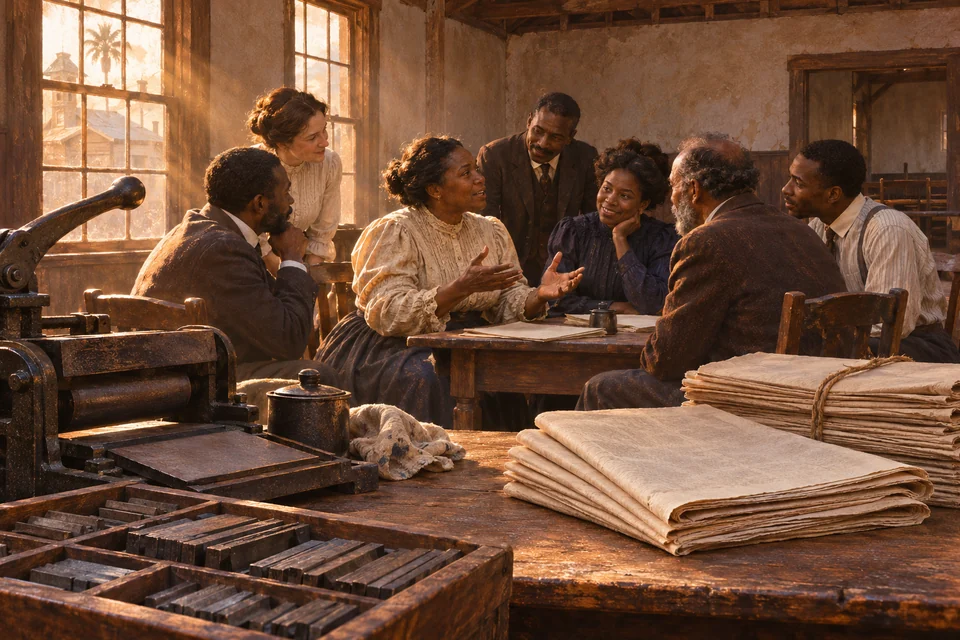
The featured artwork is an imagined illustration of people and printing materials from the period. The surviving issues linked below let you see the original publication for yourself.
What did the September 1906 issue say was happening?
The first issue traced the meetings from a home gathering to Azusa Street. It described long services, crowded altar times, and people seeking God in prayer. It also printed accounts of conversion, sanctification, speaking in tongues, and healing. Those reports show what the mission thought readers needed to know about its worship and teaching.
The issue describes people arriving early and staying late, sometimes well into the night. That detail makes the account more specific than the broad claim that revival was underway. The issue also gives space to teaching about forgiveness, holiness, and the Holy Spirit. A reader encountering the mission through the paper could see both what participants were seeking and how the editors explained it.
Some reports describe people who said their sight or hearing improved. These are historical records of what the mission published. A medical conclusion about an individual would require evidence beyond the printed testimony. Readers can take the witnesses’ words seriously while describing the evidence with care.
What did the newspaper mean by calling the revival Pentecost?
The paper interpreted what people reported in Los Angeles in light of Acts 2. Contributors drew a connection between speaking in tongues at the mission and the disciples’ experience at Pentecost. Acts itself describes people in Jerusalem hearing God’s works proclaimed in languages they recognized, and the crowd asks what the event means.
Acts 2:11 (KJV) records what the listeners heard. The disciples were speaking “the wonderful works of God.” Verse 12 records the crowd’s question, “What meaneth this?” Put those verses beside the first issue. The Biblical passage tells us what Luke says happened in Jerusalem. The newspaper tells us how Pentecostal believers in 1906 understood their own experience.
That distinction helps with a question near the center of the story. When the paper reported that someone had received a language for missionary work, what would show that other speakers could understand it? The paper preserves some claims of recognition, and a reader can ask whether a particular report identifies the language, the listener, or what was understood. That makes it possible to read each report on its own evidence.
How did a local mission reach people who never attended?
The mission offered the paper free and asked readers to send mailing addresses, including addresses of other people who might want a copy. The first issue announced a print run of 5,000. The October issue reported workers going out and carried news from places beyond Azusa Street, including a report about meetings in Oakland.
The invitation to send an address gave readers a practical part in distributing the paper. Someone could receive a copy, ask that it continue, or suggest another recipient. The October issue also reports people writing from different places to ask about the revival. This two-way exchange helps explain why the paper is valuable for studying how the message traveled.
An Assemblies of God historical account identifies William J. Seymour and Clara Lum as editors and describes the paper’s distribution at home and abroad. That history and the archive help document the publication. The individual issues let us examine the claims and expectations that traveled with it.
Oakland is a useful example of the difference between a report and a head count. The October item names people associated with the visit and records totals in several categories. Those figures are the newspaper’s account. The names and location give a historian leads to check against other surviving records. Even when a second record is unavailable, the item still shows what the editors chose to count and considered worth telling their readers.
How can Christians read the Azusa testimonies with discernment?
Read an issue with two questions in mind. What did the contributor actually report, and what conclusion did the editors draw from it? Then ask what the cited passage teaches in context. That approach leaves room for gratitude, careful historical work, and honest questions about details the surviving account cannot settle.
Paul tells the Thessalonians to pray and give thanks, to take spiritual utterances seriously, and to test what they hear. The KJV renders his instruction in 1 Thessalonians 5:21 as “Prove all things; hold fast that which is good.” In this setting, careful testing belongs alongside an openness to the work of the Spirit. The same habits help when we hear a testimony in church or pass one along.
Vince Baker Ministries’ overview of early Pentecostal history places Azusa within a wider story that includes earlier Holiness networks and later local movements. This newspaper offers a close-up of one community within that history. For a ministry perspective on revival and Christian readiness, the related book is Last Days Revival.
What can you do this week?
Open the September 1906 issue and choose one report. Write three lines titled “What the paper says,” “What I can verify,” and “What Scripture teaches.” Read Acts 2:5–12 before filling in the third line. Use those distinctions if you share the report with someone else.
Read the Scripture passages
Sources
- The Apostolic Faith, September 1906, vol. 1, no. 1
- The Apostolic Faith, October 1906, vol. 1, no. 2
- Azusa Papers collection and scans of original issues
- Flower Pentecostal Heritage Center publication guide
- Assemblies of God history of William J. Seymour and Azusa Street
- Vince Baker Ministries overview of the Pentecostal movement