
Place it in church history
- Era
- Medieval Christianity
- Key dates
- Sixth through fifteenth centuries
- Location
- Europe, Africa, and Asia
Find Medieval Christianity on the interactive timeline.
Published by Vince Baker Ministries ·
How did Christian life develop across regions?
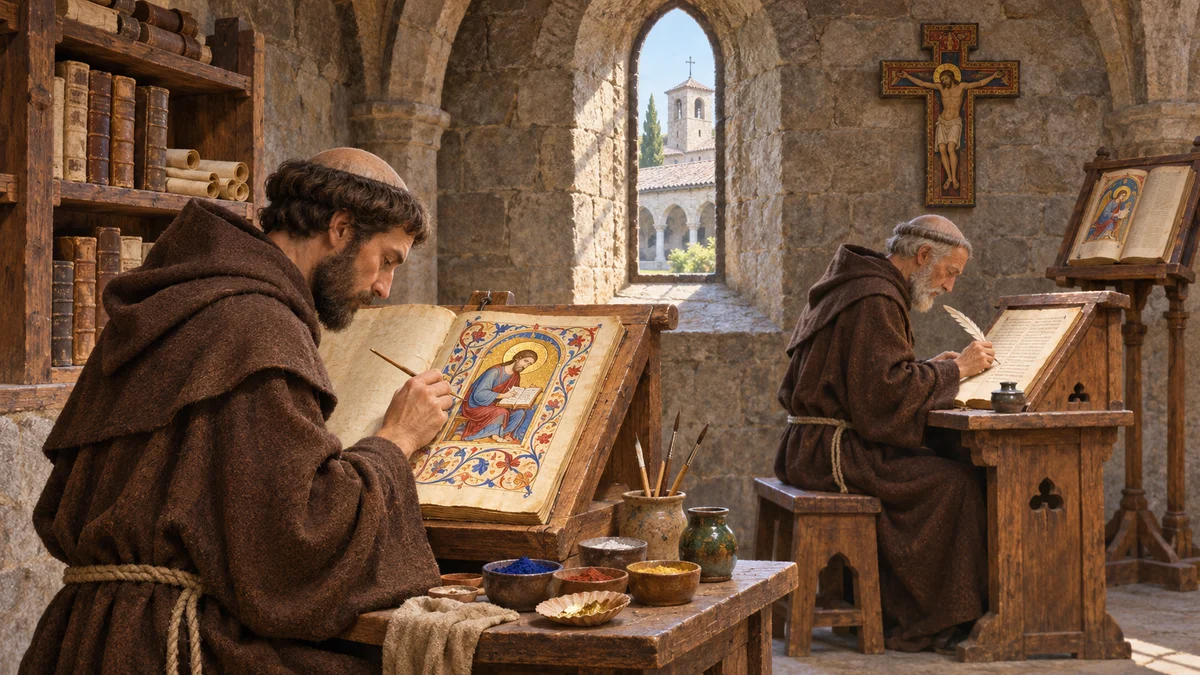
Monasteries became centers of prayer, learning, hospitality, and service. Benedict’s Rule gave many Western communities a lasting pattern. In the East, ancient monastic and liturgical traditions continued alongside Christian communities in Ethiopia, Armenia, and across the Middle East. The Church of the East carried its faith along trade routes, and the Xi’an stele, erected in 781, records a Christian presence in Tang China.
How did translation help spread the Gospel?
In the ninth century, Cyril and Methodius served among Slavic peoples. They developed a way to write the language and translated Christian texts for worship and teaching. Their work illustrates the importance of language in mission. Medieval Christianity also includes women such as Hildegard of Bingen, whose writing, music, and leadership reached beyond her own religious community, and Catherine of Siena, who corresponded with church leaders and pressed for reform.
Why does 1054 matter?
Excommunications exchanged in 1054 are often used to mark the East–West Schism. Differences in authority, theology, worship, and political loyalties had accumulated over centuries. The sack of Constantinople by crusaders in 1204 deepened the rupture. Both dates help explain why the separation developed over time and why reunion has been difficult.
What can readers learn from this era?
Francis of Assisi and Clare of Assisi formed communities known for simplicity and service. Their choices sit alongside the era’s wealth, power, and violence. Read John 17:20–23 and ask how shared confession, care for neighbors, and accountability might change the way Christians handle real differences today.
Scripture to read alongside the history
- Psalm 119:105 · KJV
- Matthew 28:18-20 · KJV
- John 17:20-23 · KJV
Historical sources
- Britannica, Benedict of Nursia and his Rule
- Britannica, missions and monasticism
- Britannica, the Church of the East and its expansion
- Britannica, Cyril and Methodius
- Britannica, East–West Schism
- Britannica, the Crusades
- Britannica, Hildegard of Bingen
- Britannica, Clare of Assisi
- Britannica, Catherine of Siena